
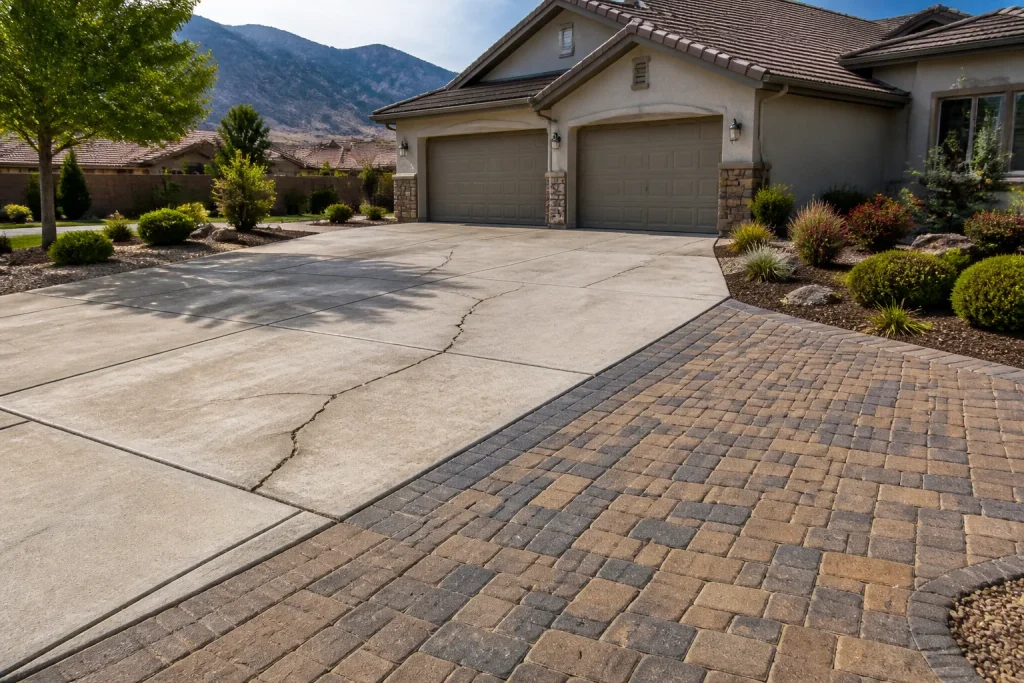
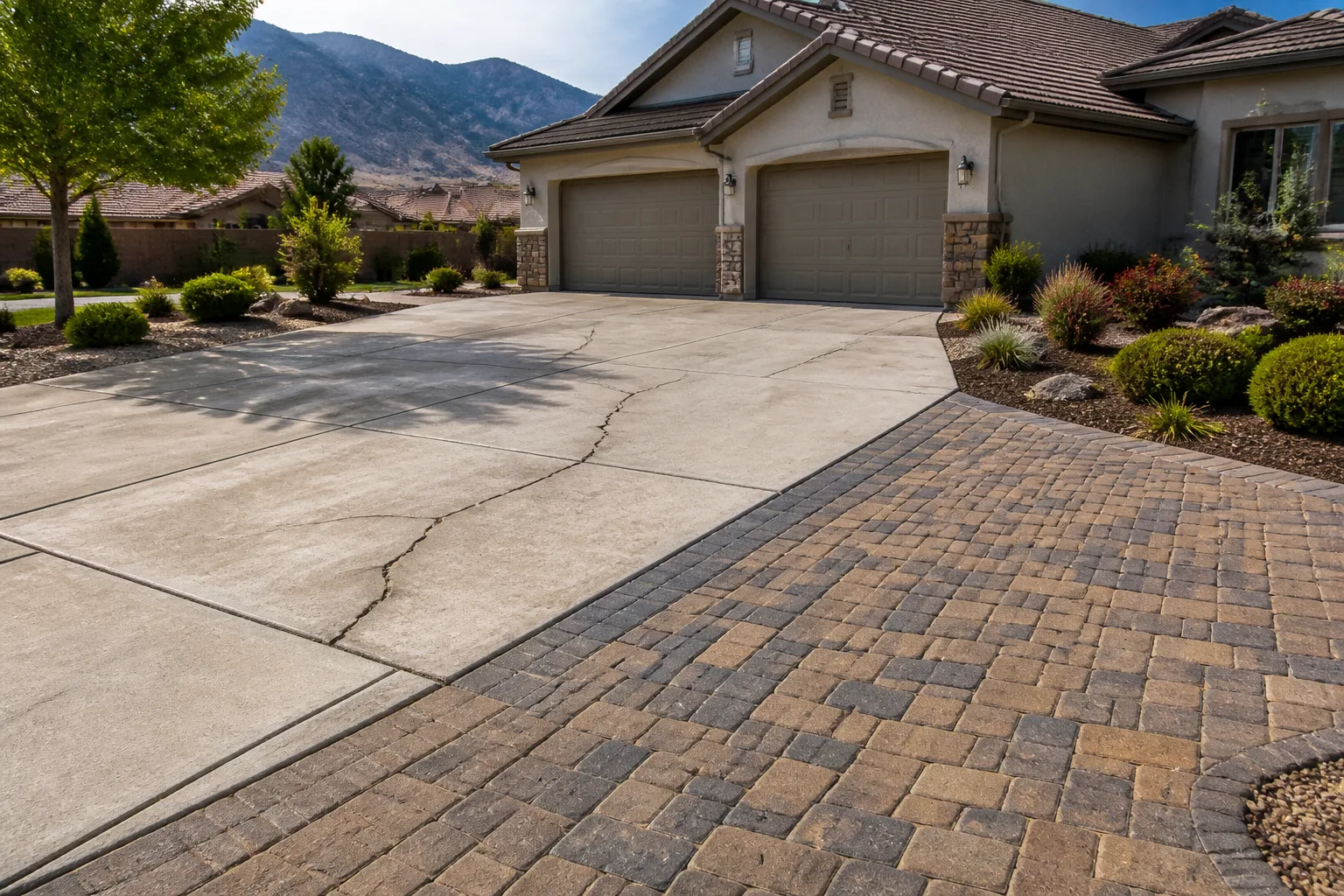
Driveway & Pavers: Repair or Replace? How Enterprise Homeowners Decide
Here’s the four-minute test that settles most repair-or-replace arguments before a single dollar gets quoted. Pull one paver from the worst-looking section of the driveway and look at the bedding sand underneath. If the sand is dry, compact, and sitting at the right depth, you have a surface problem and a repair will hold. If that sand is wet, washed out, or the base beneath it moves underfoot, you have a base problem, and no amount of new pavers on top will fix it. In our experience across Enterprise, that single observation separates a $400 repair from a $6,000 replacement.
If you’d rather have someone do the pulling and the reading, call (833) 630-4077 and we’ll take a look at no charge.
Why the Base, Not the Surface, Is the Whole Decision
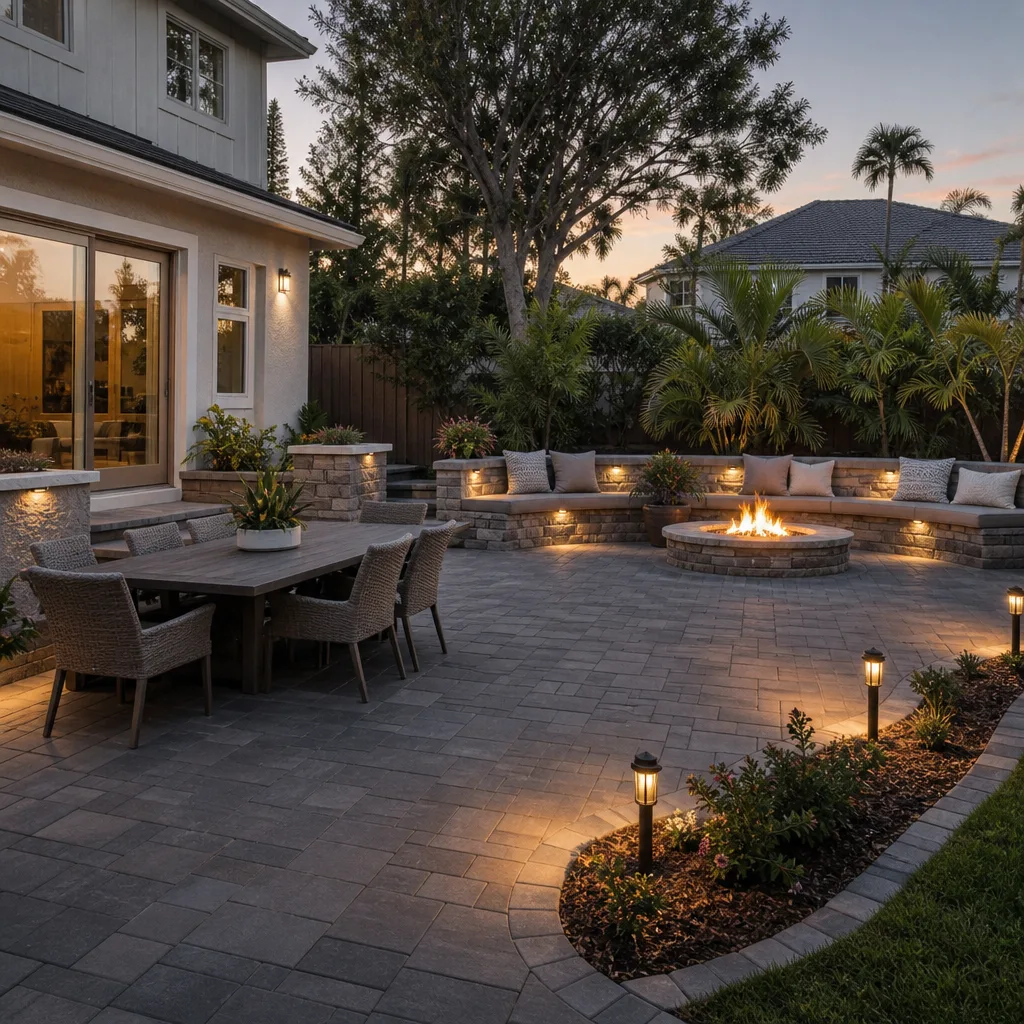
A paver driveway is a layered system: subgrade soil at the bottom, a compacted aggregate base above it, a geotextile fabric between the two, a sand bedding layer on top of the base, the pavers themselves, and joint sand swept into the gaps. When people say their driveway is “failing,” they’re almost always describing the surface. The pavers have shifted, a few are cracked, the joints are spitting sand. But the surface is only reading the base. If the base is sound, the fix is cosmetic. If the base has failed, the surface is just the first thing to show it.
This is why pulling a paver matters. It’s the only way to tell what’s happening underneath without tearing out a section. In Enterprise, we see two failure patterns over and over: driveways on the valley’s caliche-heavy soil where the subgrade was never prepped deep enough, and driveways where the geotextile was skipped to save a few hundred dollars at install. Both look identical to sun-bleached pavers until you pull one.
The Base Inspection Protocol: What to Look For Under One Paver
When we pull a paver on an Enterprise driveway, we check four things in a fixed order. Any homeowner can do the same with a flat pry bar and a pair of gloves.
- Bedding sand depth. Bedding sand should sit about 1 inch thick, uniformly, under the paver. If it’s deeper than an inch and a half, or if it varies more than a quarter inch across the paver’s footprint, the install was likely rushed and the pavers will keep shifting.
- Moisture intrusion. Dry sand means water is shedding properly. Damp or saturated sand means water is getting underneath, which means either the slope has failed or the joint sand has washed out and let rain straight through.
- Geotextile condition. If there’s a fabric layer between the sand and the aggregate base, check it’s intact. Torn or missing fabric allows fines from the base to migrate up into the bedding sand, and once that happens, the whole layer loses compaction.
- Subgrade stability. Push a screwdriver down through the aggregate base. If it goes in easily and the surrounding stone shifts, the base was never compacted correctly and no surface repair will hold for more than one season.
Each finding points a different direction. Dry sand and intact fabric favor repair. Wet sand, missing fabric, or a spongy base favors replacement.
The 30% Rule: When Repair Stops Penciling Out
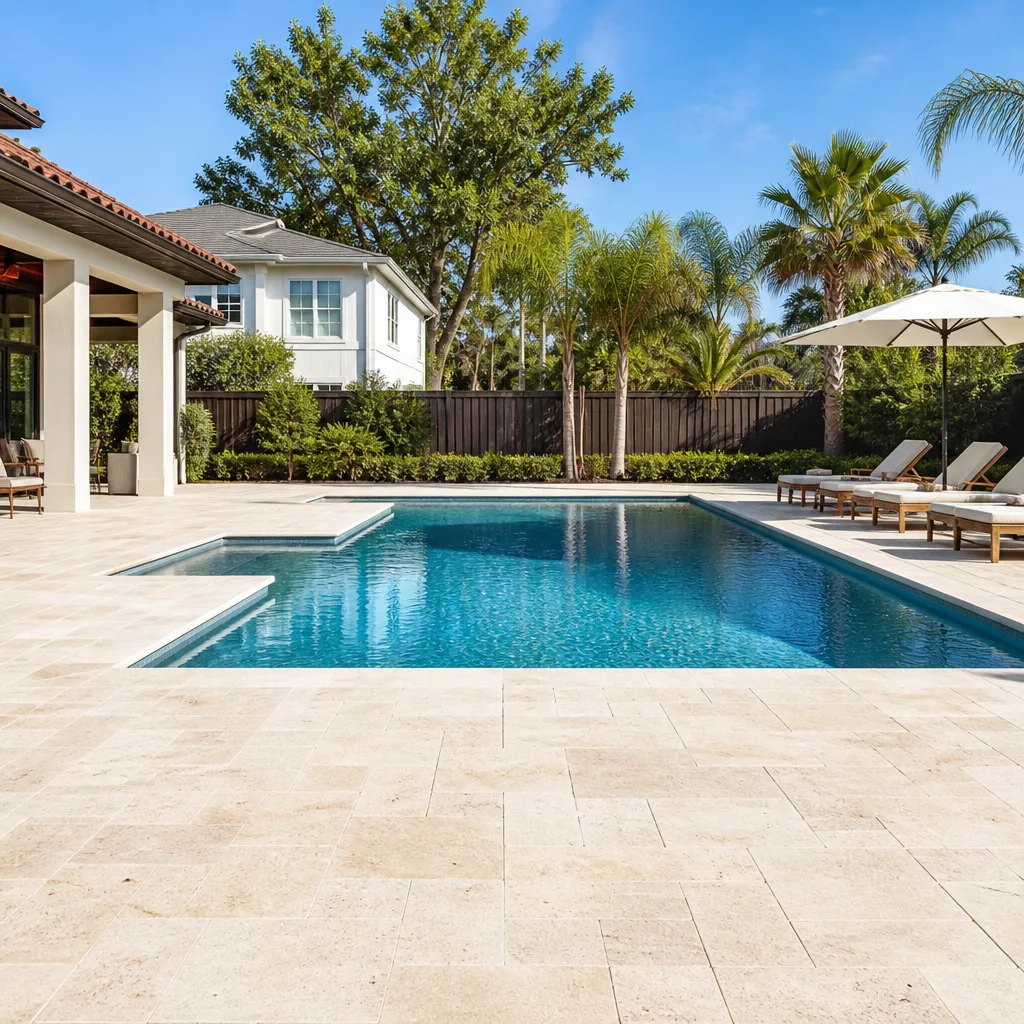
There’s a threshold that most contractors won’t put on paper because it’s easier to just sell the replacement. Here it is anyway: when visible surface damage covers more than roughly 30% of the driveway’s total square footage, replacement typically costs less per square foot over a 10-year horizon than a string of sequential repairs. Below that threshold, targeted repair usually wins.
Here’s how the math breaks down on a typical 600-square-foot Enterprise driveway:
- Spot repair (under 30% damage). Pull and reset affected pavers, recompact the base in the affected area, replace joint sand. Runs around $350 to $700 depending on the section size.
- Section repair (one bay or half the driveway). Roughly $1,200 to $2,400, assuming base recompaction is needed but the rest of the driveway is sound.
- Full replacement. Runs $6,000 to $12,000 for a 600-square-foot driveway with a properly rebuilt base and new Belgard or Techo-Bloc pavers. That’s higher than most national averages because Southern Nevada’s base prep has to go deeper to break through caliche.
The compounding problem is real. Three spot repairs over five years can approach replacement cost while still leaving you with a driveway that looks patched. If you’re looking at the second repair in three years, run the numbers on replacement before committing to a third.
How Enterprise Temperatures Attack the Base Layer
This is the part that doesn’t apply to homeowners in Seattle or Phoenix in quite the same way. Enterprise sees a legitimate 110°F swing through the summer and dips to 28°F in winter. That cycle lives directly in your driveway’s base.
Summer heat causes the pavers and base aggregate to expand. When the base is already marginal, that expansion squeezes joint sand out through the gaps, and once the joint sand is gone, water has an open path down to the geotextile and bedding sand. Winter cold then contracts everything, and the freeze cycle pulls moisture up from the subgrade in the form of ice lenses. Spring arrives, the ice melts, and the base that was marginally compacted in fall is now loose and saturated.
The practical result: a repair done in Enterprise in June often fails by the following March, because the same thermal cycling that created the original problem will do the same thing to the patch. A repair on a base that’s already shown moisture intrusion in an Enterprise driveway has a realistic expected lifespan of one to three seasons. A repair on a sound, correctly compacted base holds ten years or more.
If you’re planning new construction or a replacement rebuild, that thermal stress is exactly why base depth and geotextile spec matter more than paver color. We spec the same deeper base on every driveway we build for that reason.
What a Written Repair Scope Must Include
A repair quoted as “reset the affected pavers” is the beginning of a second phone call in a year. A repair scope that actually solves the problem names the following items in writing, in this order:
- Excavation depth per section. How deep the crew will dig before rebuilding the base, measured in inches. Anything less than four inches of rebuilt aggregate in Enterprise is a cosmetic job, not a repair.
- Base recompaction spec. The subgrade and aggregate base need to be recompacted with plate compaction in lifts of no more than two inches. If the written scope doesn’t say “recompacted,” assume it won’t be.
- Geotextile replacement. Any torn fabric must be replaced, not patched over. This is a $20 material cost on most repairs and skipping it costs the whole job.
- Joint sand type. Standard joint sand is fine in areas of low traffic, but joint-stabilizing polymeric sand holds up better against Enterprise’s summer expansion. Ask which one is being used.
- Edge restraint condition. The plastic or aluminum edge restraint along the driveway’s perimeter holds the pavers in place. If it’s cracked or pulled out, the pavers will creep regardless of what you do to the base. It has to be checked and replaced where needed.
Any of our written quotes itemize every one of those line items before a tool comes off the truck. Under Clause 1 of the Haven Standard, the price is written before anyone starts, and no additional work proceeds without a signed change order.
The Sunk Cost Question
Here’s where homeowners talk themselves into the wrong decision almost every time. The original base work on the driveway cost something, maybe $2,000 to $3,000 of the original install. When the base has failed, it’s tempting to reason that rebuilding the base “throws away” that investment. It does. But that money is spent either way.
The question isn’t what the base cost. It’s what the driveway is worth going forward. If the original install is ten or fewer years old and the base failure is localized, a targeted rebuild of the failed section plus repair of the rest usually pencils out. If the install is fifteen-plus years old, the pavers are already at end of life, and the base has failed more than once, replacement is the honest answer. The original base investment is a sunk cost in both scenarios.
We had a call out to a driveway over near the Aliante area recently where the homeowner had a written quote for a full replacement and a second quote for a $900 repair. The pavement looked moderate at the surface. One paver pulled up showed the bedding sand bone dry and the geotextile intact. The repair was the right call, and we told the homeowner so. That’s the free second opinion we offer on any written estimate: bring a competitor’s quote and we’ll review it line by line at no charge.
When to Call a Pro
The inspection protocol above is safe to perform: you’re pulling one paver, looking, and putting it back. Safe as long as the paver isn’t sitting on a base that’s already collapsed, and you’re pulling from a quiet section, not the edge of a drop-off.
Where it stops being a homeowner job is any repair that requires recompaction. Plate compactors are heavy, and misusing them on a half-compacted base does more harm than good. Any repair involving excavation below the bedding sand, any repair where the subgrade has failed, and any replacement where you’re rebuilding the base from the subgrade up needs a trained crew. The equipment and the sequencing matter more than the pavers do.
If the inspection points toward replacement, get a written scope and a flat price before anyone touches the driveway. If it points toward repair, get the same. Don’t accept a verbal estimate on either.
Related services in Enterprise
If that inspection is pointing toward a full rebuild, our Driveway & Pavers in Enterprise page covers base prep, paver brands we source (Belgard and Techo-Bloc among others), and what a written replacement scope looks like. Homeowners doing driveway work often have a fencing project queued behind it, and our Fence Installation in Enterprise page covers that side of the yard. If a hardscape rebuild has you thinking about a bigger project that includes an addition or an ADU, our Home Additions & ADU in Enterprise page covers that scope. You can find every trade we cover on the Rowan Construction Group Enterprise home page.
What happens when you call
- 1
A real person answersNo phone trees – you reach a local pro.
- 2
You get an upfront price rangeHonest numbers before anyone is dispatched.
- 3
A background-checked tech heads outLicensed & insured, dispatched right away.
- 4
You approve before work beginsNothing starts until you say go.
The Bottom Line
For Enterprise homeowners weighing driveway paver repair vs. replace, the decision rests on one finding: base failure or surface failure. Surface-only damage almost always favors repair. Base failure almost always favors replacement. The 30% damage threshold is the financial shorthand for when replacement starts to pencil out over a 10-year horizon, and Enterprise’s 110°F to 28°F swing accelerates base deterioration in ways that shorten the life of repair on a compromised base.
If you’re in Enterprise and need help with the inspection or a written quote on either path, Rowan Construction Group Enterprise offers free estimates. Call (833) 630-4077 to schedule yours. Our technicians have up to 19 years of experience, every project comes with a flat written price and a written scope before work begins, and any change requires a signed change order. Every visit includes a documented photo record so you can see what we found and what we did.
Frequently Asked Questions
Spot repairs on a driveway in Enterprise typically run $350 to $700 for a small section with intact base underneath. Section repairs that include base recompaction run $1,200 to $2,400. Full replacement of a 600-square-foot driveway runs $6,000 to $12,000 depending on paver selection and base rebuild depth. Call (833) 630-4077 for an exact quote on your driveway. Estimates are free.
You can perform the pull-and-check inspection yourself, and small cosmetic issues like regrading joint sand are within reach. Any repair that requires base recompaction, excavation below the bedding sand, or edge restraint work needs a trained crew. Those items determine whether the repair holds more than one season, and getting them wrong costs more than the original repair. Call (833) 630-4077 if you want a written scope before deciding.
A repair on a sound base holds 10 years or more. A repair on a base that has already shown moisture intrusion or missing geotextile typically lasts one to three seasons because Enterprise’s summer heat-expansion and winter freeze cycle re-creates the original failure. Getting the honest answer means assessing the base before committing to the repair, not after. Call (833) 630-4077 to schedule an inspection.
No. Under Clause 1 of the Haven Standard, the price is written before any work starts, broken into line items with a written scope and a written warranty. If something changes mid-project (a base issue discovered under a paver, a hidden crack in the edge restraint), no work proceeds until the change order is signed. That practice is what has kept our projects within a few percent of the agreed cost across 4,000-plus jobs. Call (833) 630-4077 to get a written quote.
Written by the team at Rowan Construction Group Enterprise.
Need Construction Help?
Call Rowan Construction Group Enterprise - licensed & insured, here with fast after-hours help in Enterprise.
(833) 630-4077