
Driveway & Pavers What It Really Costs: What Enterprise Homeowners Pay in 2026
A 600-square-foot paver driveway in Enterprise quoted at $8 per square foot and one quoted at $14 per square foot can end up within $400 of each other once the low bidder’s change orders land. The gap isn’t the price. It’s what each quote includes on page one. Most homeowners compare the bottom line and stop there. In the Enterprise market, that habit is what turns a $7,200 quote into a $12,400 invoice.
Below is a complete, line-item cost model for a 2026 Enterprise paver driveway. Use it to line up any two quotes side by side. If reading it makes you want a written number instead, call (833) 630-4077 and we’ll price yours in writing before anyone touches a shovel.
What does a paver driveway cost in Enterprise in 2026?
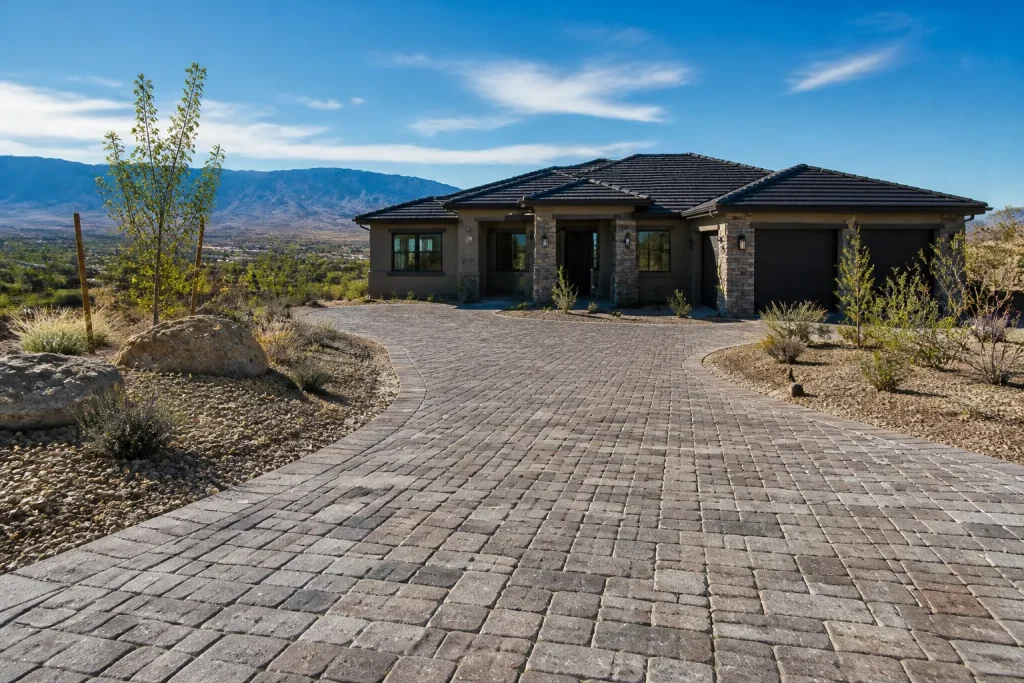
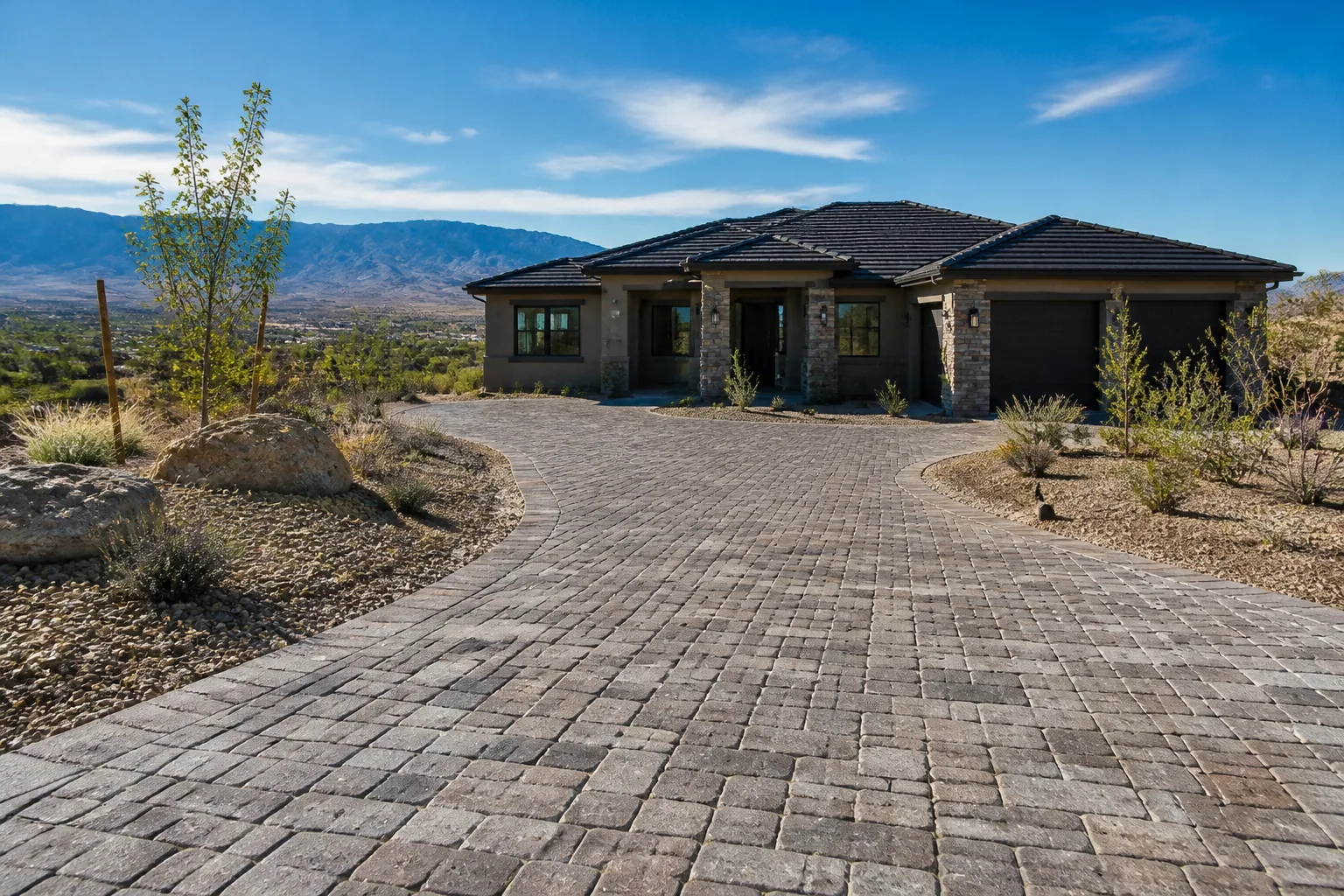
A complete paver driveway in Enterprise runs $8,400 to $22,000 for a 600-square-foot single-car apron, or $14 to $28 per square foot installed depending on material tier. The surface pavers are often the smallest part of that number. Excavation, base, fabric, edge restraints, and sealer are where the money goes.
Here’s the line-by-line model we use to build a written quote. Every number below is an installed cost in dollars per square foot:
- Excavation and disposal: $1.50 to $2.25/sq ft. Depends entirely on what’s under your driveway.
- 6-inch compacted aggregate base: $2.00 to $2.80/sq ft. This is what carries the load. Skip it and the pavers shift within two seasons.
- Geotextile fabric: $0.30 to $0.60/sq ft. Separates the base from native soil so fine particles don’t migrate up and destabilize the bed.
- Concrete pavers: $4.00 to $6.00/sq ft.
- Natural stone pavers: $12.00 to $18.00/sq ft.
- Edge restraints: $0.75 to $1.50/sq ft. The aluminum or PVC channel that stops the field from spreading.
- Sealer: $0.50 to $1.00/sq ft. Optional at install, near-mandatory after the first year in the desert.
Run that math on a 600-square-foot concrete paver driveway and you land between roughly $8,400 and $13,000 for a complete, honest build. If a quote comes in at $5,600, that’s not a bargain. It’s a partial job.
Why Clark County soil changes the excavation line
Enterprise sits on two very different subgrades, and the difference can swing your excavation cost by $450 on a single driveway. Caliche hardpan is calcium carbonate cemented into a rock-like layer that has to be broken with a breaker or mini-excavator. Sandy fill, common in newer subdivisions, digs fine but won’t compact to spec without stabilization. A contractor who bids both the same hasn’t looked.
We’ve seen this play out in the field. Over in the older pockets near the Enterprise alignment, driveways routinely hit caliche six inches down, and the excavation line reflects it. In newer tracts off the south side, we’ve pulled sandy fill that needed a geotextile layer just to hold grade. Neither condition is a surprise to a contractor who walks the site before quoting. Both are surprises to one who quotes from a satellite photo.
Ask any contractor quoting your Enterprise driveway one question before you compare numbers: what did you find when you probed the base? If they can’t answer, the excavation line is a guess, and guesses turn into change orders.
Which three line items disappear from Enterprise low bids?
Base excavation, geotextile fabric, and edge restraints are the three items missing from most low-bid paver quotes in the Enterprise market. Added back as change orders, they typically add $900 to $1,950 to a 600-square-foot driveway after the deal is signed. Sealer is a close fourth.
Here is what each one costs when it lands on the invoice as a change order rather than in the original scope:
- Base excavation: $900 to $1,350. The crew digs, finds caliche, and informs you the original price “assumed clean soil.”
- Geotextile fabric: $180 to $360. Rarely spelled out in a low bid, but it’s the layer that keeps your pavers level for a decade.
- Edge restraints: $450 to $900. Without them, the field spreads under tire traffic and the joints open up. This is the one homeowners most often discover in year two.
- Sealer: $300 to $600, if it was in the scope at all.
Add those four and a $5,600 quote is a $7,400 job. Which is within a few hundred dollars of the honest $8,400 bid. The low bidder wasn’t cheaper. They just hadn’t told you the price yet.
This is exactly why Clause 1 of The Haven Standard exists: the written price comes before the work starts, every time. No change proceeds until the change order is signed. That discipline is what our teams have built across more than 4,000 residential projects, and it’s why our projects finish within a few percent of the agreed figure.
What a real allowance line looks like vs. a vague placeholder
A legitimate allowance line names a dollar amount, a unit, and a consequence: “Base excavation allowance: $1,200 for up to 4 inches of caliche removal. Additional hardpan over 4 inches billed at $18 per square foot with a signed change order.” A vague placeholder says “excavation as needed” or “soil conditions TBD.” One is a price. The other is a promise to charge you later.
Read any written proposal for these five signals:
- Unit and quantity: a real allowance states the dollar figure and what it covers in square feet or cubic yards.
- A floor and a ceiling: good quotes give you a range up front, not an open-ended “we’ll see.”
- A trigger: the proposal should name the condition (caliche, buried utilities, existing concrete) that turns the allowance into a change.
- A change-order requirement: no additional charge without your signature. Under the Haven Standard, that’s contractual, not a courtesy.
- Material brands named: a real quote names the paver manufacturer. Belgard and Techo-Bloc are common in Enterprise installations, and a written line naming the specific paver style tells you exactly what you’re getting.
If you already have a written estimate from another contractor, we’ll review it line by line at no charge. Bring it in. If it’s honest, we’ll tell you.
Related services in Enterprise: our Driveway & Pavers in Enterprise page has flat written pricing for full installs.
How do you use a cost model to negotiate a paver quote?
You negotiate with a written cost model by attacking the lines that carry margin and leaving the lines fixed by material costs alone. Material costs are roughly what they are. Labor, waste factor, and mobilization are where the contractor has room.
Here’s which lines move and which don’t:
- Fixed by material cost: pavers, fabric, edge channel. A contractor discounting pavers below the market rate is either buying cheaper pavers or eating margin they’ll recover elsewhere.
- Negotiable by scope: mobilization and waste factor. Ask for the waste percentage. Anything over 10 percent on a simple rectangular driveway is padding.
- Negotiable by timing: scheduling flexibility during slower season can shave the labor line. Ask directly.
- Never negotiable: base depth and excavation. A contractor who drops the base to hit a number is selling you a driveway that fails. Walk.
One more use of the cost model: use it to spot padding. If a quote shows excavation at $4 per square foot with no explanation of soil conditions, ask. One in our Enterprise market this spring listed an “aggregate base upgrade” at $5.20 per square foot on top of an already-included base. Same product, twice billed. We caught it during a second-opinion review. Bring us a competitor’s quote and we’ll do the same for yours, no charge.
When to call a pro
Paver driveways sit in the one zone where a homeowner-level mistake gets expensive fast: excavation and base compaction. If a contractor’s quote has an unclear excavation line, an allowance with no number attached, or no mention of compaction testing, call us before you sign. The compaction spec matters more than the paver brand, and any contractor who can’t quote it in writing hasn’t planned for it.
Two things worth flagging for anyone considering a self-install in Enterprise: Clark County requires a right-of-way permit if your driveway apron touches a public sidewalk or street, and the caliche problem doesn’t care how handy you are. One bad compaction pass on the base and the pavers telegraph every flaw within a year. A phone call before digging is cheaper than a tear-out.
If you’re weighing a paver driveway against other hardscape projects, the Rowan Construction Group Enterprise home page shows all seven trades we handle. Fence or gateway work alongside a paver driveway is common enough that our team plans both in one scope; the Fence Installation in Enterprise page covers that side. And if a detached garage or covered parking pad is part of the plan, the Home Additions & ADU in Enterprise page walks through what that costs.
The Bottom Line
A paver driveway in Enterprise costs between $8,400 and $22,000 in 2026, and the surface pavers are the smallest variable in that range. Four lines decide the real number: excavation, base, edge restraints, and sealer. Quotes below $8 per square foot almost always leave one or more of those out, then add them back at change-order prices. Our technicians have up to 19 years of experience reading Enterprise soil, and every quote we write is flat-priced with the full scope in writing before work starts.
If you’re in Enterprise and want a written number you can compare, Rowan Construction Group Enterprise offers free estimates, and we’ll review any competitor quote line by line at no charge. Call (833) 630-4077 to schedule yours.
Frequently Asked Questions
A complete 600-square-foot paver driveway in Enterprise runs $8,400 to $13,000 with concrete pavers and $14,000 to $22,000 with natural stone in 2026. The range reflects excavation conditions more than paver choice. Call (833) 630-4077 for an exact quote, written and flat-priced before work starts.
Low paver quotes in the Enterprise market usually drop base excavation, geotextile fabric, edge restraints, or sealer from the initial scope. Those four lines add $1,830 to $3,210 on a 600-square-foot job once they’re billed as change orders. A quote below $8 per square foot is a partial job, not a bargain. Call (833) 630-4077 for a second opinion on any written estimate at no charge.
You need a Clark County right-of-way permit only if the driveway apron connects to a public sidewalk or street. Interior driveway work doesn’t require one. A contractor who hasn’t asked about your apron hasn’t planned the permit. Call (833) 630-4077 and we’ll walk through what applies to your Enterprise address.
A standard 600-square-foot paver driveway takes three to five working days from excavation to sealer, weather permitting. Caliche excavation can add a day. Sealer needs 24 to 48 hours to cure before you drive on it. Call (833) 630-4077 to get a written scope with a firm timeline.
Concrete pavers don’t crack from typical Las Vegas Valley heat when installed over a properly compacted base with edge restraints. Poor base compaction is what causes shifting and joint failure, not temperature. The base matters more than the paver brand. Call (833) 630-4077 for a written quote that specifies base depth and compaction.
Written by the team at Rowan Construction Group Enterprise.
Need Construction Help?
Call Rowan Construction Group Enterprise - licensed & insured, here with fast after-hours help in Enterprise.
(833) 630-4077