Last updated November 18, 2026




Free written scope consultation - allowances, timeline, and change-order rules on paper before a single trade is scheduled
Driveway & Pavers Maintenance Checklist for Enterprise Homeowners
Polymeric sand, the gray filler locked between your pavers, has a working lifespan of three to five years in a desert climate. Most Enterprise homeowners find out it has failed the hard way: weeds push through the joints, ants tunnel into the bedding layer, and the base course loosens underneath a surface that still looks fine from the street. Enterprise throws three separate forces at a driveway – 110°F summers, monsoon runoff, and alkaline caliche soil – and a single annual sealer coat answers none of them. This checklist assigns a specific task to each mechanism on a schedule you can actually keep, and tells you which jobs are yours and which need a plate compactor and fresh sand.
Quick Answer
A paver driveway in Enterprise needs three scheduled interventions, not one: a quarterly joint and edge inspection, a re-sanding every three to four years with polymeric sand rated for desert UV, and a penetrating silane sealer reapplied every two to three years. Test sealer failure with a water-bead test each spring. Anything beyond joint refill, weed pulling, and surface cleaning – settled sections, washout under the base, efflorescence that returns after two cleanings – belongs with a contractor who can pull the field and rebuild the bedding course.
Styles & brands we work with
- Kitchen remodeling
- Bathroom remodeling
- Home additions & ADU
- Roofing
- Windows & doors
- Driveway & pavers
- Fence
Table of Contents
- The Three Failure Modes Specific to Enterprise
- How to Test Whether Your Sealer Has Failed
- Month-by-Month Maintenance Calendar for Enterprise
- Which Sealer Types Survive Desert UV
- Efflorescence and Alkaline Caliche Groundwater
- Monsoon Washout: What to Check After a Storm
- What Re-Sanding Costs in Enterprise
- Documentation: Photos to Keep and When to Call
The Three Failure Modes Specific to Enterprise
Most paver care advice is written for a wet climate with mild sun. Applied in Enterprise, it misses the actual damage. We’ve seen three distinct mechanisms at work on driveways across the valley, and each one needs a different response.
UV spalling. Two decades of 110°F summers bake the surface of a paver and the binder in film-forming sealers. The paver face flakes in shallow chips, usually on the sun-exposed south and west runs of the drive. Once the face opens, moisture gets in and freeze-thaw cycles in January – Enterprise does dip below freezing at night – widen the chip.
Alkaline efflorescence from caliche groundwater. Enterprise sits on caliche, a calcium carbonate hardpan that pushes salts up through the base when irrigation or rain wets the subgrade. Those salts crystallize on the paver face as a white bloom. On a slab driveway that chalky film is cosmetic. On pavers it signals moisture moving through the bedding sand, which is a base-course warning.
Subsurface washout during monsoon. July through September, Enterprise gets intense short-duration rain. Water sheets off hardpan that won’t absorb it and finds the lowest point – usually the apron where the driveway meets the street, or a low corner near a downspout. Sand washes out from under the pavers, and the surface settles into a dish. A driveway that looks level can have a void beneath it you can hear when you walk across it.
Paver maintenance in a milder market is largely cosmetic. Here it is a structural discipline. For a full look at how these drives are built in the first place, see our Driveway & Pavers in Enterprise service page.
How to Test Whether Your Sealer Has Failed
You do not need a contractor to answer this question. You need a cup of water and three minutes. The water-bead test tells you in plain terms whether the sealer is still doing its job.
- Pick three spots: one full-sun area, one shaded area, and one in the path of runoff.
- Pour roughly a quarter cup of water on each spot and watch for sixty seconds.
- If the water beads and rolls off, the sealer is intact.
- If the water darkens the paver and soaks in within thirty seconds, the sealer has failed at that spot.
- If some spots bead and others drink, the sealer is failing unevenly and you’re due for a recoat.
Run the test in spring, after the last frost has passed and before the heat sets in. Do it before you buy a new sealer and before you pressure-wash – pressure-washing an intact sealer strips it, and you’ll be redoing a job that didn’t need doing. On a film-forming acrylic, a failed test often shows as a milky or chalky film that scuffs under a thumbnail. On a penetrating silane, there’s no film to see; the soak test is the only reliable signal. Photograph each test spot for your records, since a comparison photo from the same spot a year earlier is worth more than any verbal description when you call a contractor.
Month-by-Month Maintenance Calendar for Enterprise
The schedule below separates what you can do yourself from what needs a plate compactor, fresh polymeric sand, and a contractor’s eye on the base. Enterprise’s seasons drive the timing – work done in July at midday can cook a sealer before it cures.
Your DIY Inspection List
- January: Walk the drive after a cold night and look for heaved or rocked pavers. Freeze-thaw opens joints.
- February: Pull winter weeds from joints by hand. Photograph the drive.
- March: Run the water-bead test on all three zones. Note failures.
- April: Sweep and rinse the surface. Check edge restraints and the sand joint line.
- May: Inspect for efflorescence and record where it appears.
- June: Pre-monsoon check – make sure drainage paths away from the drive are clear.
- July-September: After each heavy storm, walk the drive and listen for hollow spots.
- October: Post-monsoon inspection; note any settled sections.
- November: Clean out debris from the street apron and any low corner.
- December: Pull weeds, photograph, and plan spring re-sanding if the joints are low.
Tasks That Require a Contractor
- Refilling joints with fresh polymeric sand, which needs a plate compactor and proper joint activation.
- Pulling and resetting settled pavers when the bedding course has washed out.
- Applying a penetrating sealer correctly – over-application on a desert drive pools and cures unevenly.
- Any repair to edge restraints, which keep the field from spreading.
Notice the calendar runs on inspection and small maintenance most months, with the heavier work landing in spring and fall. That’s the rhythm a desert drive expects, and it beats waiting for a problem to announce itself.
Which Sealer Types Survive Desert UV
Two sealer families dominate the market, and only one belongs on an Enterprise driveway.
Penetrating silane and siloxane sealers soak into the paver and line the pores from the inside. They leave no film, so there’s nothing for UV to chalk or peel. They typically hold two to three years in our climate and can be recoated without stripping. The trade-off is that they don’t change the paver’s appearance much, so if you want a wet-look gloss, this isn’t it.
Film-forming acrylic sealers sit on top and give a glossy finish. They also take the full brunt of UV and start to chalk or peel within a year or two on a sun-exposed run. Stripping a failed acrylic is labor, and repeated strippings wear the paver face. If a homeowner insists on a film, look for an acrylic formulated for high-UV exposure and expect to redo it sooner than a silane.
Application timing matters as much as product choice. Seal in spring or fall when the surface temperature is moderate, not in the middle of a July afternoon. Over-applying a penetrating sealer – more is not better – leaves a haze you may not see until it cures. A contractor who knows this climate will pick the product and the window; the wrong sealer applied in the wrong month is money spent on future rework.
Efflorescence and Alkaline Caliche Groundwater
That white haze on your pavers is not dirt. It is salt, carried up from the caliche hardpan beneath Enterprise by moisture and deposited on the surface as the water evaporates. It matters because it tells you where water is moving through the base.
A light bloom can be scrubbed with a stiff brush and a diluted vinegar solution in a 4:1 mix. Rinse and let it dry. If it returns within a month or two, the salts are still being fed, and the fix is drainage and base, not more brushing. Chronic efflorescence – the kind that comes back after two cleanings – usually points to a wet subgrade that needs either better drainage away from the paver field or a re-graded bedding course. This is where caliche and monsoon runoff conspire: irrigation overspray or a downspout dumping next to the drive keeps the hardpan wet, and the salt keeps rising.
In our experience, the Enterprise driveways that stay efflorescence-free are the ones where the water path was designed. French drains, a properly sloped apron, and directing downspouts well away from the field solve a problem that no sealer can. If the bloom keeps coming back, that’s a signal to have the drainage reviewed before you spend on another cleaning.
Monsoon Washout: What to Check After a Storm
After a monsoon cell rolls through Enterprise, give the drive ten minutes. Walk it slowly and listen. A hollow knock under a paver means the bedding sand is gone and there’s a void beneath. A gentle dip in the surface, especially at the street apron or a low corner, means water settled there and undercut the base.
Check these spots in order:
- The apron where the drive meets the street – the lowest, most exposed point.
- Low corners near downspouts or irrigation heads.
- The edge line, where the pavers meet the retaining restraint.
- Any place your irrigation overshoots onto the pavers.
Small joints that have lost a few grains of sand can wait for your spring re-sand. A section that has visibly settled should be evaluated quickly, because washout that’s allowed to continue undermines more of the field and turns a sanding job into a rebuild. If you see a void, don’t drive heavy loads across that spot until it’s checked. Our Fence Installation in Enterprise crews often catch these same washout patterns at the property line, since drainage that hits the drive frequently runs to the fence too.
What Re-Sanding Costs in Enterprise
Re-sanding is the single most important maintenance task for your joints, and it’s also the one most homeowners get wrong by doing it themselves with the wrong sand. Here are honest Enterprise material and labor ranges so you know when to call versus when to DIY.
- Polymeric sand (the material): roughly $30 to $45 per 50-pound bag at a local supplier, and a typical single-family driveway needs 8 to 15 bags for a full re-fill.
- DIY re-sand: material cost plus a rented plate compactor (about $60 to $100 per day), and roughly a full weekend of work for a standard two-car drive.
- Professional re-sanding: roughly $1.75 to $3.50 per square foot in the Enterprise market, so a 600-square-foot drive lands around $1,050 to $2,100 in labor and material combined.
- Sealer (penetrating silane): material for a 600-square-foot drive runs roughly $150 to $350; professional application typically doubles that with labor.
If the joints are simply low and the field is flat, DIY is reasonable for a patient homeowner. If the drive is showing settled sections, uneven joints, or recurring efflorescence, spend the money on a contractor who can re-set the field and rebuild the bedding course, because sanding over a compromised base is sand that will wash out again within a season. Under our written-price rule, you get the number before any work starts, and there is no charge for a second opinion on a competitor’s quote.
Documentation: Photos to Keep and When to Call
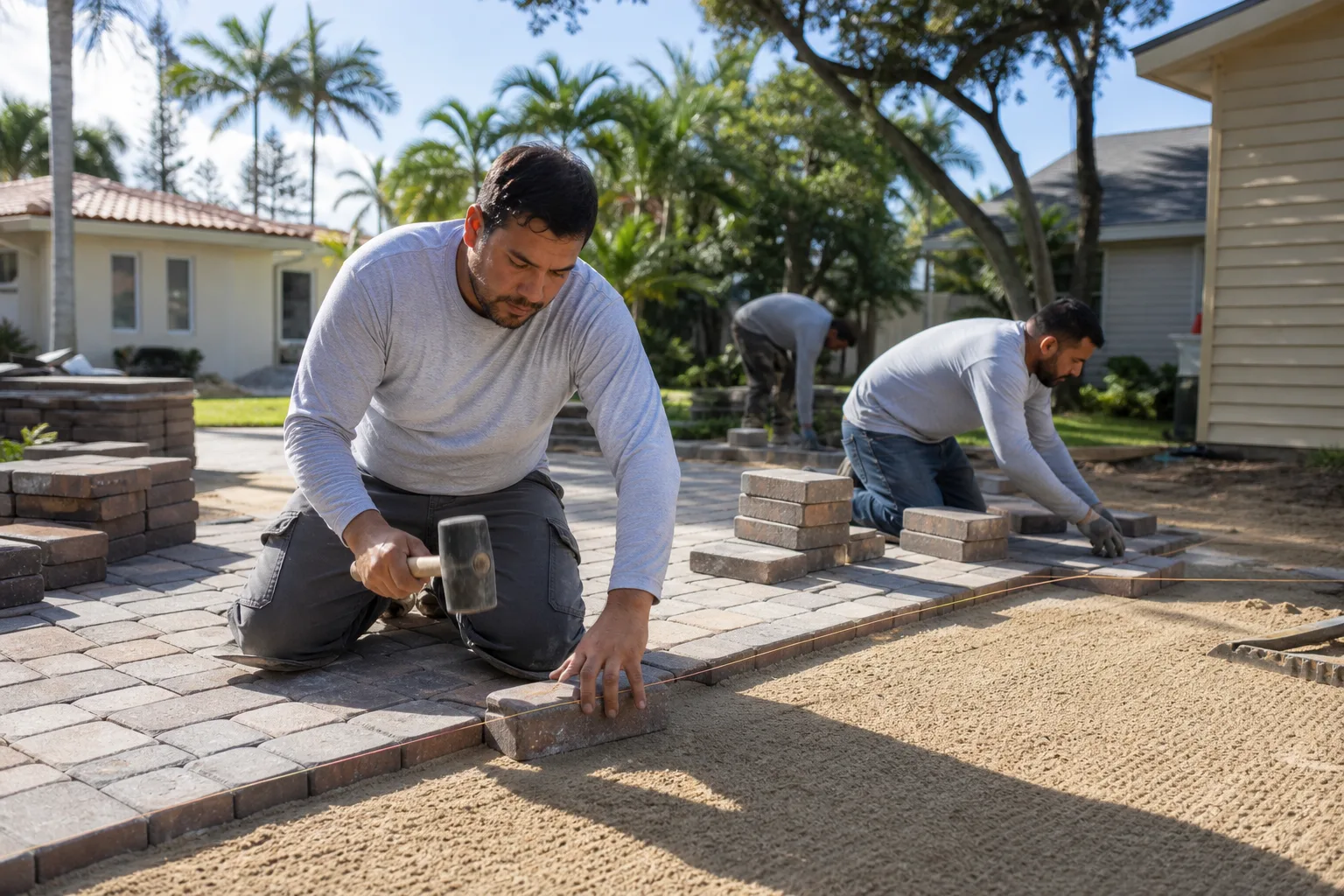
The most useful thing a homeowner can do for a paver drive costs nothing: keep a photo record. A comparison photo from the same spot at the same angle, taken each season, shows a contractor more than any verbal description. Use a fixed reference point, like the edge of the drive or a landscape light, so the framing repeats.
Keep these four shots each season:
- A wide shot of the whole drive from the street.
- A close-up of the joints at the apron.
- Any area with efflorescence or discoloration.
- A test spot for the water-bead test, with a note on whether it beaded or soaked.
When does maintenance cross into structural repair? Three signs: a settled section that has moved more than half an inch from its neighbors, a hollow knock that spans more than a couple of pavers, or efflorescence that returns within a month of cleaning. Each of those points to a base-course problem, and base repair needs the field pulled, the bedding rebuilt, and the pavers recompacted. That’s the line. Below it, you’re maintaining. Above it, you’re rebuilding, and rebuilding is best done by a contractor with the right equipment. This is the same documentation discipline we apply to Home Additions & ADU in Enterprise projects, where a photo record is standard deliverable on every visit, and it’s what we bring to paver work too.
Common Mistakes to Avoid
- Pressure-washing an intact sealer. High pressure strips a working sealer and opens the joints, forcing a reseal you didn’t need. Test first, wash gently.
- Using regular masonry or play sand in the joints. Standard sand washes out in one monsoon. Polymeric sand rated for desert UV is the only product that survives an Enterprise summer.
- Skipping the plate compactor on a DIY re-sand. Sand poured in without compaction settles loose and blows out. If you don’t have or rent a compactor, call a contractor.
- Sealing over wet pavers. Trapped moisture under a fresh sealer causes a milky film and traps salts from the caliche. Wait for a dry stretch.
- Ignoring a small dip at the street apron. That’s the first place monsoon runoff undercuts the base, and a small dip becomes a void.
- Pulling weeds without fixing the joint. A weed that comes back means the joint is open and sand has washed out. Refill the joint, don’t just yank the plant.
- Choosing a film-forming acrylic for a full-sun drive. It chalks and peels fast under Enterprise UV. Penetrating silane holds longer.
See the difference
 Before
 After
 Before
 After
 Before
 After
When to Call a Professional
Call a contractor when the problem is under the surface, not on it. Settled sections, hollow knocks across several pavers, efflorescence that returns within a month, edging that has spread, or a washout void at the apron all mean the base course needs attention that a bag of sand and a weekend can’t fix. Re-sanding on a compromised base is wasted money. Equipment matters too: proper compaction, joint activation, and sealer application all depend on tools most homeowners don’t own. Rowan Construction Group Enterprise offers free estimates in Enterprise – call (833) 630-4077. Under the Haven Standard, you get a written, flat price and a written scope before anyone picks up a tool, and no change proceeds without a signed change order. Our background-checked, uniformed technicians include a documented photo record with every visit, so you know exactly what was found and what was done.
Frequently Asked Questions
Every three to four years, assuming the polymeric sand was installed correctly to begin with. In Enterprise’s climate, UV and monsoon runoff degrade the joint sand faster than in a mild climate, so low joints after three years are normal. If the joints are already losing sand after one season, the initial install is suspect and worth having reviewed.
Professional re-sanding runs roughly $1.75 to $3.50 per square foot in the Enterprise market, so a 600-square-foot driveway typically lands between $1,050 and $2,100 in labor and material. Doing it yourself cuts the labor but requires a rented plate compactor and the right polymeric sand. Call (833) 630-4077 for an exact quote – estimates are free.
Penetrating silane or siloxane is the better choice for a sun-exposed Enterprise drive. It leaves no film for UV to chalk or peel and typically holds two to three years. A film-forming acrylic gives a gloss but degrades faster under our UV load and can require stripping.
That’s efflorescence, salt from Enterprise’s caliche hardpan carried to the surface by moisture and left behind as the water evaporates. A light bloom scrubs off with a diluted vinegar solution. If it returns within a month or two, the subgrade is staying wet and the drainage needs attention.
Yes, but at low pressure and only after the water-bead test shows the sealer has already failed. High-pressure washing strips an intact sealer and widens the joints. Use a gentle setting and re-sand any joints that open up.
Not at Rowan. You get a flat written price and a written scope before any work begins, and no change proceeds until a change order is signed. That’s the discipline that’s kept our projects within a few percent of the agreed cost, and it’s why we can offer a free second opinion on any competitor’s written estimate – we’ll review it line by line at no charge. Call (833) 630-4077 to schedule yours.
The Bottom Line
Your Enterprise paver driveway is fighting three things at once – UV, caliche salts, and monsoon runoff – and a single annual sealer coat doesn’t address any of them properly. Run the water-bead test each spring. Keep the joints full with UV-rated polymeric sand every three to four years. Watch the apron and low corners after every monsoon. And keep a photo record each season so you can spot when a small dip crosses from maintenance into base-course repair. Do those four things and a well-built paver drive will outlast the concrete slab next door. When the work needs a compactor and a fresh bedding course, that’s our line. Rowan Construction Group Enterprise brings a written price, a documented record, and a done-right guarantee to every job.
For a free estimate on paver maintenance or repair in Enterprise, call (833) 630-4077. Start at our Rowan Construction Group Enterprise home to see the full range of trades we cover, and we’ll walk your drive, name the number, and put it in writing before anything starts.
Written by the team at Rowan Construction Group Enterprise.